Most LED video walls are flat rectangles, and for good reason. They’re simple to build, easy to service, and they fit most rooms and applications. But some spaces call for something different: a wall that curves around a stage, a screen that wraps a column, or a display shaped to match the architecture instead of fighting it.
That’s where flexible and custom-shape LED screens come in. They open up designs a flat wall can’t touch, but they also ask more of the planning process. This guide covers what flexible LED is, where it earns its place, and what to work out before you request a quote.
What is a Flexible LED Screen?
A flexible LED screen is built from panels that can bend instead of sitting perfectly flat. Standard panels hold their shape, so a “curved” wall made from them is really a series of flat segments set at slight angles. Flexible panels follow the curve itself, which gives you a smoother line and more freedom in the overall shape.
Flexible vs. Custom-Shape
The two terms often get used together, but they describe different things:
- Flexible refers to the panel. It can bend inward (concave) or outward (convex) to follow a curved surface.
- Custom-shape refers to the finished display. It might be a wave, a ribbon, a circle, a column wrap, or an outline cut to match a logo or room feature.
Many custom-shape projects use flexible panels, but not all of them. A display with straight edges and unusual proportions can often be built from standard panels. Part of good planning is knowing which one your design actually needs.
Where Flexible and Custom Shapes Make Sense
A curved or shaped display costs more to design and build than a flat wall of the same size. It pays off when the shape does real work for the space, not just when it looks interesting in a rendering. Here’s some spaces we’ve found flexible displays can make a big impact.
Worship Spaces and Stages
A concave wall that wraps behind a worship stage pulls the whole room toward the platform. Viewers on the far sides see the screen more directly than they would with a flat wall, and the display feels like part of the set instead of a TV hung on the back wall.
Lobbies, Atriums, and Retail
Columns and curved walls are common in lobbies and stores, and they’re often the most visible surfaces in the room. Wrapping a column or following a curved wall turns an architectural feature into a place for branding, wayfinding, or donor recognition without adding a freestanding structure.
Museums, Galleries, and Exhibits
Exhibit designers use curves and custom shapes to guide visitors through a space and build immersive scenes. A display that bends around a gallery corner or forms a ribbon overhead can carry a story in a way a row of flat screens can’t.
Studios and Event Sets
Curved backdrops give camera operators more usable angles and help virtual or in-camera backgrounds look natural. For events, a shaped centerpiece gives the stage a signature look that photographs well.
When a Flat Wall Is the Better Call
If the main goal is clear, readable content for a seated audience straight ahead, a flat wall usually does the job at a lower cost. Flexible LED is the right tool when the shape solves a sightline problem, fits an architectural feature, or creates an experience the space needs.
How to Plan a Flexible LED Display
The display is only as good as the plan behind it. These are the questions to decide on early, ideally before anyone draws a final design.
1. Define the Curve
Start with the direction and the tightness of the curve. Is the screen bending inward toward the audience, outward around a column, or both, as in a wave? How tight is the tightest point?
Every flexible panel has a limit on how far it can bend without stressing the LEDs and circuitry. A gentle curve along a wall is easy for most flexible products. A small-diameter column or a tight wave needs a closer look at the panel’s bend rating, so share actual measurements, not just an “idea”.
2. Plan the Structure Behind It
Flexible panels don’t hold a curve on their own. They mount to a frame or substructure built to the exact shape of the finished display. That frame is where much of a custom project’s engineering happens.
The frame has to match the curve closely, or the seams between panels will show. It also has to carry power and data to every panel and leave a clear path for service. Plan who designs and builds it, and how it attaches to the wall, ceiling, or floor.
3. Choose a Pixel Pitch for Your Viewing Distance
Pixel pitch works the same way on a curved screen as on a flat one. Use the 10x Rule: multiply the pixel pitch in millimeters by 10 to get the closest comfortable viewing distance in feet. A 1.5mm pitch looks sharp from about 15 feet and beyond, while a 2.5mm pitch suits viewers 25 feet or more away.
Curves can bring parts of the screen closer to the audience than you’d expect. On a column wrap or a lobby wall, people may walk right past it, so size the pitch for the closest viewers, not the average.
4. Build Content for the Shape
A custom shape usually means a custom resolution. Content made for a standard 16:9 screen will stretch, crop, or leave empty space. Plan your content early: who creates it, what canvas size they design for, and how the processor maps it to the physical shape.
The best custom displays use content designed for them, such as motion that flows along a curve or graphics that follow a column all the way around.
5. Think About Service From Day One
Curved and shaped displays often sit in tight spots, against walls, or high overhead. Front-access panels let a technician swap a module from the viewing side without reaching behind the structure. Ask how each panel comes out, and make sure there’s a way to reach every part of the display.
Where the Firefly Y Series Fits
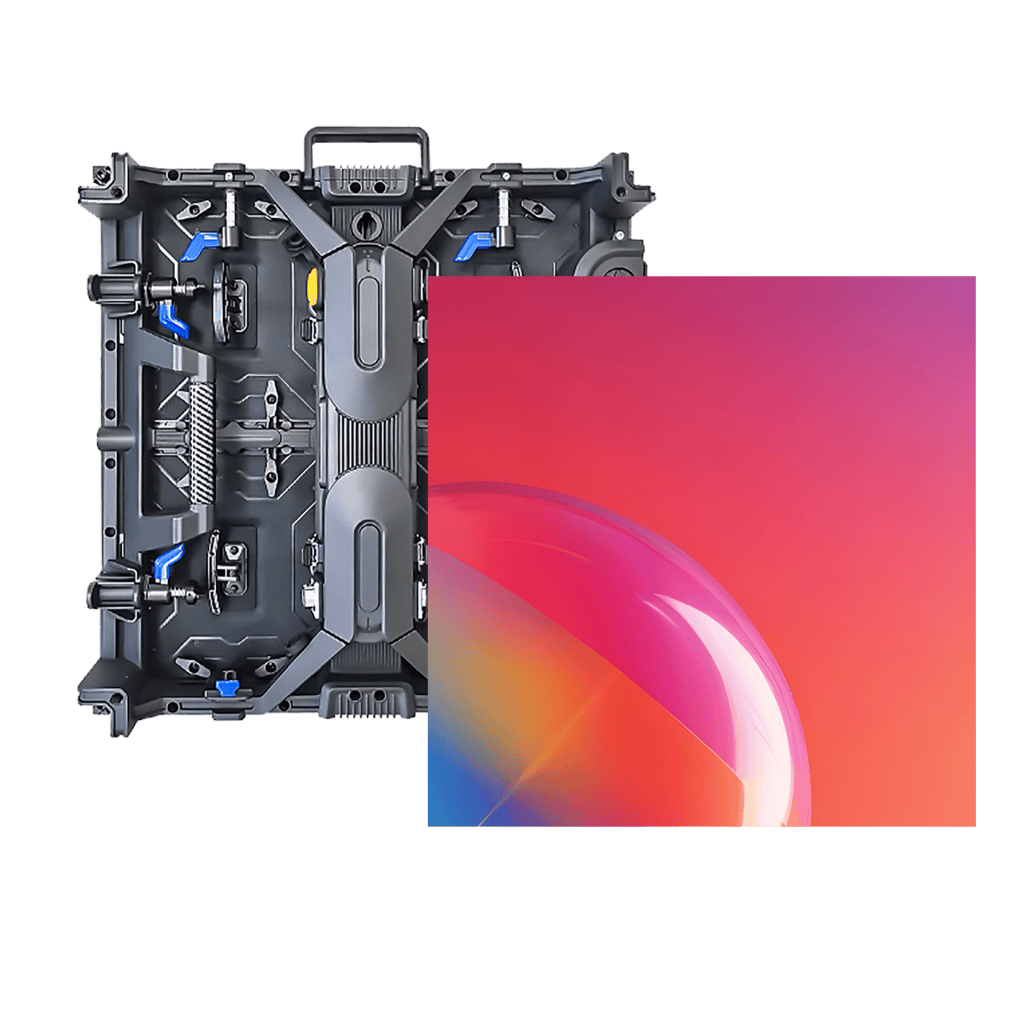
The Y Series is Firefly’s flexible indoor line, built for curved, wave-shaped, and custom video walls. It comes in pixel pitches from 0.9mm to 2.5mm and bends both inward and outward. At the 1.2mm and 1.5mm pitches, it can curve around a circle as small as about 4 to 4.5 feet across. Its front-access panels make service easier, and it works alongside standard flat panels, so one display can combine straight runs with curved sections.
For a real-world example, see how Firefly used the Y Series at Lowe’s headquarters in Charlotte, including a custom display shaped like the Lowe’s logo above the front desk.
Flexible Panels vs. Angled Flat Panels
You don’t always need flexible panels to get a curve. Standard panels can be set at small angles to each other to create a curved wall, sometimes called a faceted curve. Each approach has its place.
When Angled Flat Panels Work
For a large, gentle curve viewed from a distance, angled flat panels often look smooth enough and cost less. They also share parts and service steps with the rest of a standard install.
When Flexible Panels Are Worth It
Flexible panels make sense when the curve is tight, the audience is close, or the design changes direction. Column wraps, waves, and small-radius curves are hard to fake with flat segments, and the angles start to show up close. Flexible panels give you a continuous surface that holds up to a closer look.
Many projects use both: flat panels for the long straight runs and flexible panels where the shape demands it. A good design partner will tell you where each one belongs instead of pushing one answer for the whole wall.
Frequently Asked Questions
Can a flexible LED screen go outdoors?
Most flexible panels, including the Y Series, are made for indoor use. For an outdoor curve or custom shape, we recommend our outdoor M Series which has the capability to bend and curve similar to the Y.
Does a flexible LED screen cost more than a flat one?
Usually, yes. The panels, the custom frame, and the content work all add to the budget. Using flexible panels only where the shape needs them, with flat panels everywhere else, is one of the best ways to control cost.
Can flexible and flat panels be part of the same display?
Yes. Y Series panels are designed to work alongside standard flat panels, so a single display can mix straight and curved sections.
What shapes are possible?
Curves, waves, column wraps, ribbons, and many custom outlines are all possible. The limits come from how far the panels can bend and how the structure behind them is built. Share your measurements and drawings early so the design starts from what the space can support.
Ready to Shape Your Next Display?
If you already have a feel for the size, shape, and pixel pitch you need, start a Y Series custom quote in the Screen Builder. Our team will review your project and help you work through the curve, structure, and content details, then stay with you and your integrator through installation.